WarmLine → Advisor client calls
Advisory
Financial advisor client calls: when trust is the product
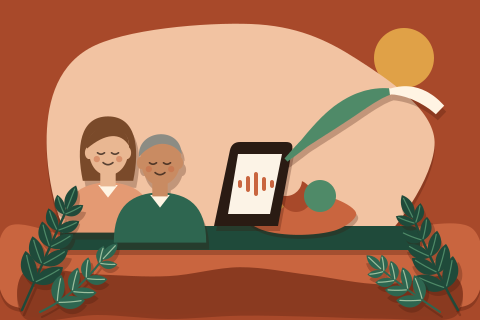
Review calls are heard on kitchen speakerphones by people who will not tell you they missed a number. Optimize for being understood — technology guidance only.
Scope, stated once and meant: this is technology guidance only. Nothing on this page — or anywhere on WarmLine — is financial advice, investment advice, or compliance advice. We write about how calls sound. Your firm's compliance team owns what may be recorded, retained, and said; ask them, not us, and follow their answer over anything here.
Advisory calls are different from other client calls in one specific way: the product is trust, and trust is transmitted almost entirely through voice. A prospect can evaluate a demo on features. A client on a quarterly review call is evaluating whether the person explaining a drawdown sounds like someone who has it handled. That judgment forms in the first sentences, and audio quality is part of it whether anyone admits it or not.
Three things that make advisory calls acoustically unusual
- Your clients are often on speakerphone. Couples take review calls together, on a kitchen counter, with a device propped against a fruit bowl. Speakerphone listening is unforgiving: it flattens dynamics and makes a noisy floor much more tiring than headphones would.
- Some of your clients don't hear as well as they did. A meaningful share of advisory relationships run for decades. Clarity and steady level stop being aesthetic preferences and become accessibility, and the client will rarely volunteer that they're struggling — they'll just agree with things they didn't catch.
- The content is numbers and consequences. Percentages, dates, account names, and the difference between "we're rebalancing" and "we're reallocating." These are exactly the phrases that a noisy line turns to mush.
Put together, those three mean an advisor should optimize for intelligibility above everything else. Not warmth, not presence, not a broadcast sound. Can a seventy-year-old on a kitchen speakerphone catch every word without effort? That's the whole test.
The setup, in advisory order
The general build is on the main setup page; what follows is four steps built from it, reordered for the specific job of being understood.
- Level first, and slightly generous. Aim for consistently present rather than dynamic. A voice that drops when you lean toward a screen is a voice that vanishes on a kitchen speakerphone.
- One suppression layer, not two. Over-stacked filters produce the clipped, slightly robotic artifacts that destroy consonants — and consonants are where "fifteen" and "fifty" live.
- Close the door and kill the notifications. A chime during a conversation about someone's retirement is a small thing that lands as a large one.
- Confirm early, not at the end. "Before we get into the numbers — am I coming through clearly on your end?" Thirty seconds, and it gives the client explicit permission to say no later.
The four steps are this page’s own checklist; the goal is every word arriving without effort.
Pace is an audio setting you control with your mouth
No filter fixes speed. Advisors under time pressure compress the technical middle of the call — the part with the actual information — and a compressed passage is the first thing a marginal line destroys and the first thing a client pretends to have understood.
Two free habits do more here than any software. Slow down specifically for numbers and named products, then restate them in a second form. And build in a genuine pause after each substantive point — not "does that make sense?", which people answer reflexively, but silence long enough for a question to surface. Silence is also diagnostic: if a client never fills your pauses, either the line is poor or they're lost, and both are worth knowing before the call ends.
Recording, archiving and the part we won't advise on
Many advisory practices already record or archive client calls, sometimes because a regulator or a firm policy says so. Two honest observations, neither of which is legal or compliance guidance.
The technical one: an archived call is a permanent copy of your input quality. If your line is noisy today, the noise is in the record, and anything that later transcribes or analyzes that file is working from the same degraded signal your client heard. Clean at the source, because nothing downstream restores what the microphone never captured well. The broader version of that argument is on conversation intelligence and your call audio.
The boundary one: what you may record, whose consent you need, how long it must be kept, and what can be processed by a third-party tool are questions for your compliance team and your jurisdiction. We have opinions about how calls sound and none whatsoever about your obligations. Ask internally before adding any tool to a client call, including the ones we write about.
What we will not tell you
We won't tell you what to say about markets, what to recommend, how to structure a portfolio review, or whether any tool satisfies your regulatory requirements. Several of those would be irresponsible for a publication about audio software to opine on, and the fact that this page is otherwise useful is exactly why the line needs stating. Technology guidance only — on this page and every advisor-facing page on this site.

Line check
If you take client calls from anywhere with a household, a shared suite, or a street outside the window, a dedicated suppression layer buys you intelligibility on the calls where being understood is the entire service. Krisp offers a 7-day trial, then $8 per user per month on the annual plan (verified 2026-09-20). Confirm with your firm before adding any software to a client call.
Hear it on your own line first
Referral tag on this button: start a Krisp subscription from it and Krisp pays WarmLine a fee. Your price is Krisp’s ordinary price, nothing added. Prefer to spend nothing? Your platform's built-in suppression plus a slower delivery on numbers covers most quiet-office advisory calls, and we'd rather you keep the money.
Questions from advisory practices
Is noise suppression allowed under our compliance policy?
We genuinely don't know, and neither does anyone else writing about audio. Suppression tools process your microphone signal and some also touch recordings or transcripts, which is precisely the kind of thing firms have views about. Ask your compliance team, name the specific tool, and follow their answer.
My clients are older and often say they can't hear me. Where do I start?
Level and pace, in that order, before any purchase. Raise your steady level slightly, slow the numbers, and run the voicemail self-test on phone speakers — which approximates a kitchen speakerphone better than your headphones ever will. If the playback is effortful for you, it's worse for them.
Does a quiet home office need any of this?
Probably not, and that's the honest answer even on a page with an affiliate link on it. A quiet room plus the built-in suppression your meeting platform already includes handles the ordinary advisory call. Spend on this only when your rooms stop cooperating.
Nothing on this page is financial, investment, tax, or compliance advice. Our full position on money, disclosure and limits is on Straight Talk.